


Optical Scope Alignment – the Basics
Optical Scope Alignments or “Scoping” for short; is the most advanced method for obtaining a perfect marine shaft alignment with struts, shaft logs, engines or v-drives. Scoping is the latest generation of alignment technology and far more advanced than the old piano wire system and even laser alignments.
The basis of a proper geometrical alignment starts with a fixed line that runs from a point in the center of an aft strut though a point in the center of an intermediate strut or shaft log. Those two points create a line and that line is the foundation for the perfect alignment. The two main tools of a scope alignment system are the scope and a number of optical targets.
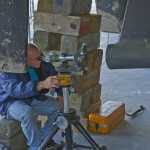
Scope Set on a 116′ Azimut
The scope is a piece of engineering or survey equipment – a telescope with a set of cross hairs – similar to a spotters scope or a scope on a riffle. Optical targets are two inch diameter pieces of glass with micro-line cross hairs in the center.
To start an alignment, an optical target must be placed in the center of the aft strut. A second optical target is placed in the center of the shaft log or exit tube. The optical scope is set up on a tripod one or two feet aft of the strut. Adjustments are made to the tripod and scope in order to focus the cross hairs of the scope with the cross hairs of the target in both the aft strut and the exit tube. This requires repeated focusing, back and forth, on the two optical targets (since the targets are clear glass you can focus through one target to see the next one in line). By carefully adjusting the scope and tripod you will eventually get both the strut and exit tube cross hairs aligned. Those two points create a perfect alignment line that is the basis for further alignment diagnostics and repair. From this point on the scope is fixed – it cannot be bumped, moved or adjusted, as this would change the alignment line.
A third optical target is place precisely in the center of the transmission output flange. Accurately placing the mirror in the center of the pilot is critical. With the scope aligned to the two main alignment points (strut and exit tube target) you can now focus the scope forward to the target on the transmission. If the cross hairs in the scope do not align with the cross hairs on the transmission you know you are out of alignment. If an advanced optical scope is used the distance
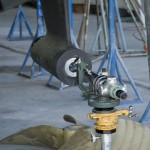
Scope and Optic in Strut
between the scope hairs and target hairs can be measured to indicate the amount of adjustment required on the engine mounts. Ultimately we are looking for an alignment within a few thousandths of an inch.
Strut Alignments – in addition to aligning the engine, a skilled optical scope technician can adjust the target to determine if a strut is in alignment.
How does an optical alignment compare to a laser alignment? A laser alignment system uses similar principals – optical targets creating a line. However, the level of accuracy is lower. A laser spot is projected onto an optic. In larger yachts the stretch distance between laser and optic may be 20 feet or more, which creates a laser spot up to one eighth of an inch in size. The human eye struggles to see the center of a dancing laser spot. As a result, error rates .050 to .100″ are possible. An optical alignment will get within .003 – .005″. Lasers also require careful handling to avoid eye damage.
How does an optical alignment compare to piano wire? Optical alignments are far simpler to set up and take down. In addition, a piano wire alignment is not accurate stretched over 15 feet or more. No matter how much weight is placed on the end of the wire it will always have a gravity drag creating a bent line that forces the base line alignment to be flawed. (Imagine the bow in power lines).
If you are looking for a highly accurate shaft alignment system that will diagnose the struts, shaft log and engine alignment then optical scope technology is the right way to go.
Now that you have the basics of an optical alignment, High Seas Yacht Service would like to introduce you to the next generation of customer oriented alignment systems – using current video technology…..
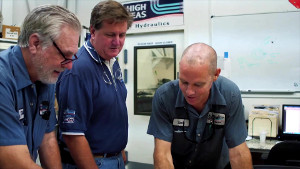 Click to watch the video of a day at High Seas Yacht Service.
 Click to watch Marine Industries Association of South Florida video featuring Salty Jobs at High Seas Services.